

What is substructure waterproofing?
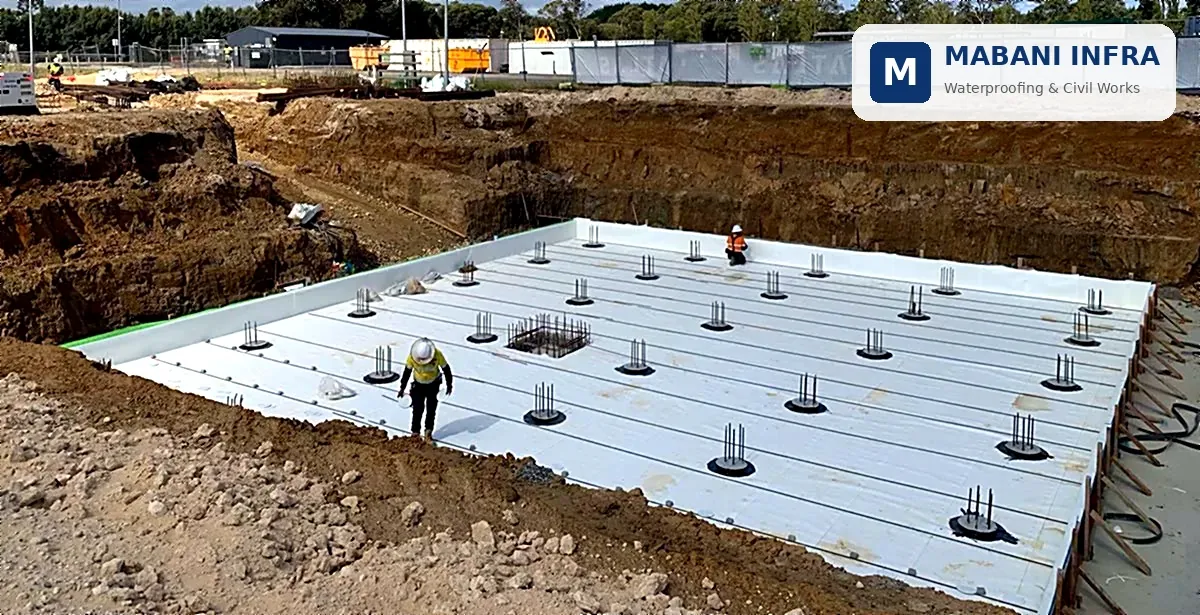
Substructure waterproofing is an external, continuous barrier that wraps the below-ground structure. A typical system starts with a pre-applied HDPE membrane laid on the blinding before the raft is cast. The membrane bonds to the fresh concrete, so any water reaching it cannot travel along the interface.
The membrane continues up the retaining walls, either pre-applied against shoring or diaphragm walls, or post-applied on the outside face after casting, with SBS or HDPE sheets. Waterstops at construction joints, sealed penetrations and protection boards complete the system.
Benefits
- Positive-side protection that keeps groundwater away from the concrete
- Bonded systems that prevent lateral water travel behind the membrane
- Protects the raft and wall reinforcement in aggressive groundwater
- Installed once, at the stage where access is easiest
Common problems and applications
Problems it solves
- High water table and hydrostatic pressure under rafts
- Soil with sulphates or chlorides that attack concrete
- Tight urban plots where walls are cast against shoring
- Construction joints and kickers acting as leak paths
- Pile heads and starter bars penetrating the membrane
Where it is used
- Raft foundations and pile caps
- Basement retaining walls, including walls cast against shoring
- Lift pits and sump pits below the raft
- Underground water tanks and STP tanks within the substructure
- Podium transfer slabs at ground level
Our substructure waterproofing process
Drawing review
We study the foundation layout, levels, pile and starter-bar positions, and the casting sequence to plan membrane laps and terminations.
Blinding inspection
The blinding must be sound, even and free of sharp protrusions and standing water before membrane installation starts.
Membrane installation
HDPE sheets are laid with sealed laps, starting from the lowest area. Corners, pile heads and penetrations receive the manufacturer's detailing components.
Inspection before steel fixing
Every lap and detail is inspected and recorded. Damage is repaired before reinforcement goes in.
Walls and joints
The membrane is continued up the walls with the specified system. Waterstops or swellable strips are fixed at construction joints.
Protection and handover
Protection boards are installed before backfill. Records with marked-up drawings are handed over.
Materials and systems used
- HDPE pre-applied membranes
- Fully bonded sheet membranes laid before concrete is poured.
- SBS modified bituminous sheets
- Post-applied on retaining walls, with primer and protection board.
- PVC and hydrophilic waterstops
- Placed in construction joints to block water travelling along the joint plane.
- Detailing tapes and pile-head kits
- Manufacturer components for laps, corners and penetrations.
- Protection and drainage boards
- Prevent damage during backfill and relieve water pressure on walls.
Products are selected from the approved specification. Coverage, thickness and curing follow the manufacturer's current data sheet.
Why professional waterproofing is important
Substructure defects are the most expensive to repair, because they sit behind or below the structure and must be fixed from the wrong side. A single unsealed lap or a punctured sheet under the raft can feed water into the whole basement.
Professional installation means checking the blinding before laying, sealing every lap to the manufacturer's method, inspecting before reinforcement fixing and protecting the membrane before anything heavy goes near it. These steps take little time on site and save years of leak repairs.
Why choose us
- Installed to the civil programme
- We plan membrane zones around pours so the civil contractor is not held up.
- Inspection at every hold point
- Laps, details and repairs are recorded before steel fixing or backfill.
- Authorised applicator
- We install HDPE and SBS systems from established manufacturers to their methods.
- One team from raft to tank
- The same crew details lift pits, sumps, tanks and joints within the substructure.
Read more about our team and how we inspect and record work.
Work photographs
Frequently asked questions
What is the difference between pre-applied and post-applied membranes?
A pre-applied membrane is laid before concrete is poured, so the concrete bonds to it. A post-applied membrane is fixed to the concrete after casting. Rafts and walls cast against shoring use pre-applied systems because there is no access afterwards.
Why use HDPE under the raft instead of a coating?
HDPE pre-applied membranes withstand construction traffic and reinforcement fixing, bond to the concrete and resist hydrostatic pressure. Coatings are better suited to accessible surfaces.
How are pile heads waterproofed?
Pile heads are treated with the membrane manufacturer's detailing components, often a combination of crystalline or cementitious treatment, sealant and tape around the starter bars, so the membrane is continuous around them.
Is substructure waterproofing the same as basement waterproofing?
They overlap. Substructure waterproofing is the external system installed during construction. Basement waterproofing also covers leak repair in existing basements.


