

What is PU injection grouting?
PU injection grouting is a leak-sealing method for concrete. Holes are drilled at an angle to intersect the crack or joint, mechanical packers with non-return valves are fixed in them, and polyurethane resin is injected with a high-pressure pump until it appears at the next packer.
Two main resin types are used. Water-reactive foaming resins react quickly with water to stop high-flow leaks. Flexible, low-viscosity resins then penetrate fine cracks and remain elastic so the seal tolerates small movements. Structural cracks that need bonding rather than sealing are treated differently, with epoxy injection.
Benefits
- Stops active, running leaks that coatings cannot hold back
- Works from the accessible side without excavation or demolition
- Flexible seal tolerates minor crack and joint movement
- Fast: areas can often be put back into use the same day
Common problems and applications
Problems it solves
- Water flowing through cracks in basement retaining walls
- Leaking construction joints between raft and walls
- Honeycombed concrete and tie-rod holes letting water through
- Leaks around pipe sleeves in tanks and lift pits
- Seepage through podium soffits and slab cracks
Where it is used
- Basements and parking levels
- Underground water tanks and sumps
- Lift pits and STP tanks
- Podium and terrace slab cracks, injected from below
- Culverts, subways and service tunnels
Our PU injection grouting process
Leak mapping
Each leak is marked, its flow observed and the crack or joint traced along its full length, including dry portions that may become leak paths.
Drilling
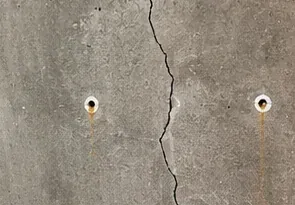
Holes are drilled at roughly 45 degrees to cross the crack at mid-depth, staggered either side, at spacings related to the wall thickness.
Packer installation
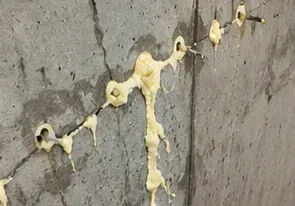
Mechanical packers are fixed and tightened. The crack surface may be sealed between packers to prevent resin escape.
Injection
Resin is injected from the lowest packer upwards. Each packer is filled until resin appears at the next one; water-reactive resin first for running water, flexible resin to complete the seal where specified.
Observation and re-injection
Points are checked after curing. Any remaining wet areas are re-injected.
Finishing
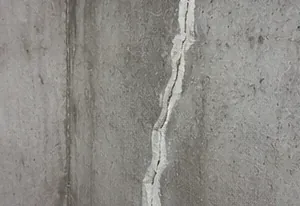
Packers are removed or cut flush, holes are filled with repair mortar and the surface is made good. Crystalline treatment may follow.
Materials and systems used
- Water-reactive PU foam resin
- Expands rapidly on contact with water to stop high-flow leaks.
- Flexible PU injection resin
- Low-viscosity resin that cures into an elastic seal in fine cracks and joints.
- Mechanical packers
- Steel or aluminium packers with non-return valves, sized to the resin and pressure.
- High-pressure injection pumps
- Electric or hand pumps that deliver controlled pressure.
- Repair mortar and crystalline slurry
- For closing holes and finishing the treated area.
Products are selected from the approved specification. Coverage, thickness and curing follow the manufacturer's current data sheet.
Why professional waterproofing is important
Injection looks simple, but results depend on hitting the crack at the right depth, using the right resin for the water flow and injecting in the right order. Packers drilled straight into the surface crack, or resin pumped too fast, simply push the leak to a new spot.
An experienced crew reads the leak, chooses the resin, spaces the packers to the concrete thickness and comes back after curing to check every point. That is the difference between a seal that lasts and one that needs repeating every monsoon.
Why choose us
- Leaks diagnosed, not just sprayed
- We trace the full crack or joint and plan packer positions before drilling.
- Right resin for the flow
- Foaming and flexible resins are used where each works best.
- Follow-up included in the method
- We inspect after curing and re-inject any remaining wet points.
- Part of a wider solution
- Injection is combined with crystalline treatment, joint repair or external work when that gives a better result.
Read more about our team and how we inspect and record work.
Work photographs
Frequently asked questions
Is PU injection a permanent solution?
PU injection gives a durable, flexible seal in the crack or joint that was injected. New cracks or untreated joints can still leak later, which is why we trace the full length of each defect and inspect after the first heavy rain.
What is the difference between PU and epoxy injection?
PU injection is for sealing leaks; it stays flexible and works in wet conditions. Epoxy injection bonds the two faces of a crack to restore structural continuity and needs a dry crack. See concrete crack repair and injection.
Can PU injection be done while water is leaking?
Yes. Water-reactive PU resin is designed for active leaks. It reacts with the water in the crack and expands to stop the flow.
Will the tank or basement need to be emptied?
Basements and lift pits can stay in use around the work area. Water tanks are usually emptied and cleaned, and the injection is done from inside.


