

What is basement waterproofing?
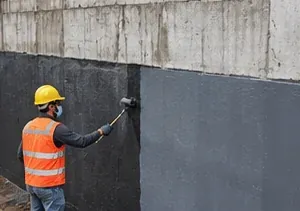
Basement waterproofing keeps groundwater and soil moisture out of below-ground floors. On new buildings it is usually achieved by a continuous membrane on the outside of the structure, under the raft and up the retaining walls (positive-side waterproofing), supported by waterstops at joints and good-quality concrete.
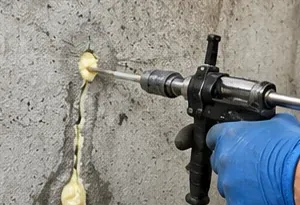
On existing basements where the outside cannot be reached, water is controlled from the inside (negative-side waterproofing) with PU injection grouting of active leaks, crystalline treatments that block the pores of the concrete, and, where needed, drainage channels and sumps that manage any residual water.
The protection level should match the use. Car parking can tolerate occasional damp patches, while plant rooms, storage and habitable spaces need a dry environment. International guidance such as BS 8102 grades basements this way, and we use the same thinking when advising clients.
Benefits
- Keeps parking, plant rooms and storage dry and usable
- Protects reinforcement from chloride-laden groundwater
- Matches the method to construction stage, water table and use of the space
- Combines membranes, injection and crystalline treatment where one method alone is not enough
Common problems and applications
Problems it solves
- Water seeping through retaining walls after heavy rain
- Leaks at construction joints between raft and walls
- Damp patches and water pooling on basement floors
- Tie-rod holes and honeycombed concrete letting water through
- Wet lift pits and sumps that will not stay dry
- Corrosion stains and spalling on basement walls and columns
Where it is used
- Residential and commercial basements with one or more levels
- Basement car parks and ramps
- Plant rooms, electrical rooms and storage below ground
- Retaining walls next to roads, nallahs and neighbouring plots
- Basements of buildings under redevelopment in Mumbai
Our basement waterproofing process
Investigation
For existing basements, we map every leak, note whether it is active or damp, and inspect joints, cracks and penetrations. For new projects, we review the soil report, water table and drawings.
Choosing the protection level
We agree with the client and consultant how dry the space needs to be, which decides the combination of systems.
New basements: external system
Pre-applied HDPE membrane under the raft, membrane on retaining walls, waterstops at construction joints, and protection board before backfill. See substructure waterproofing.
Existing basements: leak control
PU injection grouting stops active leaks through cracks and joints; crystalline slurry or coatings are applied to treated areas.
Drainage where required
Perimeter channels and sumps are added where some water ingress is acceptable but must be managed.
Inspection and monitoring
Treated areas are inspected through the next heavy rain period and any residual leaks are re-injected.
Materials and systems used
- HDPE pre-applied membranes
- Laid on blinding before the raft is cast, bonding to the fresh concrete so water cannot travel between membrane and structure.
- SBS bituminous membranes
- Torch-applied on retaining walls and rafts where specified, with protection board.
- PU injection resins
- Water-reactive and flexible polyurethane resins injected through packers to seal active leaks.
- Crystalline waterproofing
- Cementitious treatments whose chemicals react with moisture to block capillaries in the concrete.
- Waterstops and swellable strips
- PVC waterstops or hydrophilic strips cast into construction joints.
Products are selected from the approved specification. Coverage, thickness and curing follow the manufacturer's current data sheet.
Why professional basement waterproofing matters
A basement leak is never only cosmetic. Constant moisture corrodes reinforcement, damages electrical installations and makes parking floors slippery and unsafe. Every repair after construction costs more and achieves less than doing the external system properly in the first place.
Professional work means the membrane is continuous around corners, joints and penetrations, it is protected before backfill or reinforcement fixing, and each stage is inspected before it is covered. For existing basements, it means understanding where the water comes from before drilling a single packer.
Why choose us
- Both stages covered
- We install external systems on new basements and solve leaks in existing ones, so advice is not limited to one product type.
- HDPE, SBS and injection in-house
- One team handles the membrane, the joints and the leak repairs.
- Honest protection levels
- We explain what a negative-side repair can and cannot achieve compared with an external membrane.
- Experience on Mumbai sites
- High water tables, tight plots and redevelopment projects are routine for our crews.
Read more about our team and how we inspect and record work.
Work photographs
Frequently asked questions
How long does basement waterproofing last?
An external membrane installed during construction and protected before backfill is designed to last the life of the structure, because it is never exposed to sun or traffic. Internal repairs on existing basements (PU injection and crystalline treatment) are durable at the points treated, but new cracks or untreated joints can leak later, so they are inspected after the first heavy monsoon and re-injected if needed.
Can a leaking basement be waterproofed from the inside?
Yes, in many cases. Active leaks are sealed with PU injection grouting and the concrete is treated with crystalline products. Internal treatment controls leaks well but works with the water pressure against it, so it is chosen when the outside face cannot be reached.
What is the best waterproofing for a new basement in Mumbai?
For most new basements, a continuous external system is best: a pre-applied HDPE membrane under the raft, membrane on retaining walls, waterstops at construction joints and protection before backfill. The final choice depends on the water table, soil, structure and specification.
Why does water come through the construction joints?
Joints between separate concrete pours are natural weak planes. Without a waterstop or properly prepared joint, water under pressure travels along them. Existing leaking joints are usually treated by PU injection. See construction joint waterproofing.
Do you waterproof lift pits and underground tanks in the basement?
Yes. They are the deepest and most pressurised parts of the basement. See lift pit waterproofing and UG tank waterproofing.


