

What is STP tank waterproofing?
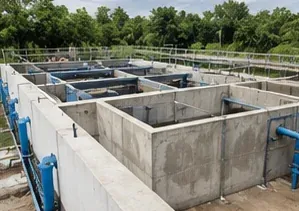
STP tank waterproofing is the protection of the concrete chambers of a sewage treatment plant, such as the collection tank, equalisation tank, aeration tank, settling tank and sludge holding tank, so that they hold sewage without leaking and resist chemical attack.
For new tanks, it usually means a crystalline or cementitious waterproofing layer plus an internal chemical-resistant lining. For existing tanks, the work typically includes cleaning, removal of damaged concrete, reinforcement treatment, repair mortars, PU injection of leaks and then a protective lining such as epoxy, epoxy-novolac or polyurea, chosen for the exposure in each chamber.
Benefits
- Stops sewage leaking into basements, soil and adjacent structures
- Protects concrete and reinforcement from acid and sulphate attack
- Linings matched to each chamber's exposure
- Planned around plant shutdown so operations resume quickly
Common problems and applications
Problems it solves
- Softened, eroded concrete above the water line from acid attack
- Exposed and corroding reinforcement inside the tank
- Leaks through walls and joints into basements or parking
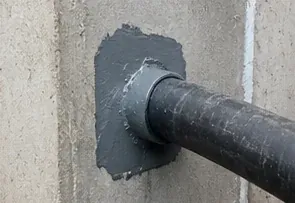
- Seepage around inlet and outlet pipes
- Failed or blistered old coatings
Where it is used
- STP tanks in residential societies and townships
- Commercial buildings, malls and hospitals
- Hotels and institutional campuses
- Effluent and wastewater tanks in industrial units
- New STP tanks under construction
Our STP tank waterproofing process
Shutdown planning and safety
The tank is isolated, emptied and ventilated. Confined-space procedures, gas checks and PPE are put in place before anyone enters.
Cleaning and assessment
Sludge and deposits are removed and the surface is pressure-washed. We sound the concrete, check reinforcement and record leak points.
Concrete repair
Weak concrete is removed, reinforcement is cleaned and primed, and sections are rebuilt with polymer-modified repair mortar. See structural concrete repair.
Leak sealing
Active leaks through cracks, joints and pipe sleeves are sealed by PU injection grouting.
Lining application
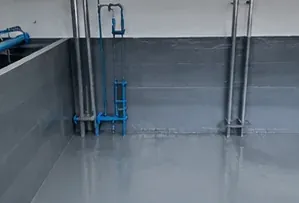
After surface preparation and moisture checks, the specified primer and chemical-resistant lining are applied in the required thickness, with special attention to corners and pipe penetrations.
Inspection and recommissioning
Thickness and continuity are checked, the lining is cured as required, and the tank is handed back for filling.
Materials and systems used
- Epoxy and epoxy-novolac linings
- High-build coatings for chemical resistance in tanks exposed to sewage and acidic conditions.
- Polyurea linings
- Fast-curing, flexible linings that reduce downtime.
- Polymer-modified repair mortars
- For rebuilding eroded and spalled concrete.
- Crystalline waterproofing
- Reduces permeability of the tank concrete beneath the lining.
- PU injection resins
- For sealing active leaks through cracks and joints.
Products are selected from the approved specification. Coverage, thickness and curing follow the manufacturer's current data sheet.
Why professional waterproofing is important
An STP tank that leaks is both a structural and a health problem. Sewage seeping into a basement creates odour and contamination complaints, and acid attack can reduce wall thickness and expose reinforcement far faster than in normal water tanks.
Professional work recognises that each chamber has a different exposure, that surfaces must be dry and sound before lining, and that confined-space entry needs proper safety control. Using a standard waterproof paint inside an STP tank rarely lasts.
Why choose us
- Exposure-based specification
- We select linings chamber by chamber rather than one coating for the whole plant.
- Repair and lining by one team
- Concrete repair, injection and lining are coordinated so each layer suits the next.
- Confined-space safety
- Gas checks, ventilation and entry procedures are part of every STP job.
- Minimum downtime
- Work is phased with the facility team so the plant is offline for as short a time as possible.
Read more about our team and how we inspect and record work.
Work photographs
Frequently asked questions
Can an STP tank be waterproofed without shutting the plant down?
The chamber being treated must be emptied, cleaned and dried. Plants with multiple chambers can often be treated in phases, keeping part of the plant running.
Why does concrete above the water line deteriorate first?
Gases released from sewage, especially hydrogen sulphide, are converted by bacteria into sulphuric acid on the moist concrete above the liquid. This attacks the cement paste and exposes the reinforcement.
Which coating is best for an STP tank?
It depends on the chamber and exposure. Epoxy and epoxy-novolac linings are common for chemical resistance; polyurea is used where faster return to service is needed. We specify after inspection.
Do you also handle the leaks into the basement?
Yes. Leaks are sealed from inside the tank by PU injection, and any damaged concrete on the basement side is repaired.


