

What is new construction waterproofing?
New construction waterproofing is the planned waterproofing of every element of a building while it is being built. Because work is done before finishes and backfill, membranes can be installed on the positive (water) side, joints can be detailed at the time of casting, and each element can be tested before it is covered.
The scope usually includes integral waterproofing admixtures in concrete where specified, substructure membranes, construction joint treatment, underground and overhead tanks, lift pits, STP tanks, sunken toilets and bathrooms, balconies and chajjas, refuge floors, podium decks, terraces and mumty roofs.
Benefits
- One contractor accountable for waterproofing across all elements
- Correct system for each element, installed at the right construction stage
- Testing before cover-up reduces defects at handover and during the liability period
- Method statements, inspection reports and work inspection requests (WIRs) for the project file
Common problems and applications
Problems it solves
- Leaks discovered at possession, after finishes are complete
- Different waterproofing vendors on different floors with no common standard
- Missed details at joints, sleeves and door thresholds
- Delays caused when waterproofing is not in the civil programme
- No records to show what was installed where
Where it is used
- Residential towers and redevelopment projects
- Commercial and IT buildings
- Institutional buildings such as schools and hospitals
- Infrastructure and staff housing colonies
- Industrial buildings and warehouses
Our new construction waterproofing process
Scope and specification review
We read the BOQ, specification and drawings, and list every waterproofing element with its system and stage.
Method statements and approvals
A method statement for each system is submitted for consultant approval, with product data sheets and inspection checklists.
Programme integration
Waterproofing activities are placed in the civil programme so that membrane laying, joint treatment and tests do not hold up pours.
Execution by element
Substructure, joints, tanks, wet areas, balconies, podium and terrace are executed in sequence by trained crews.
Inspection and testing
Each element is inspected through a work inspection request, ponding or flood-tested where applicable, and signed off before the next trade covers it.
Measurement and handover
Quantities are measured against drawings, and handover records list systems, locations and test results.
Materials and systems used
- HDPE and bituminous membranes
- For rafts, retaining walls, podiums and terraces.
- Crystalline and integral admixtures
- Added to or applied on concrete to reduce permeability where specified.
- Polymer-modified cementitious coatings
- For sunken toilets, balconies, chajjas and tank interiors.
- Liquid polyurethane membranes
- For exposed decks, terraces and complex details.
- Waterstops, swellable strips and sealants
- For construction joints, expansion joints and penetrations.
Products are selected from the approved specification. Coverage, thickness and curing follow the manufacturer's current data sheet.
Why professional waterproofing is important
Most waterproofing failures in new buildings come from gaps between trades: a sleeve fixed after the toilet was coated, a balcony door frame installed through the membrane, a construction joint left without a waterstop. These are cheap to prevent during construction and expensive to fix after occupancy.
A professional waterproofing contractor brings a scope list, method statements and hold points to the project, so waterproofing is inspected element by element and the developer has records to show buyers and consultants.
Why choose us
- Whole-building scope
- We cover every waterproofing element from raft to mumty under one contract.
- Site documentation discipline
- Method statements, WIRs, measurement sheets and daily progress reports are part of how we work.
- Programme-friendly sequencing
- We plan crews and materials around the civil cycle rather than asking the site to wait.
- Experience with large developers
- Our teams are used to consultant inspections, audits and multi-building sites.
Read more about our team and how we inspect and record work.
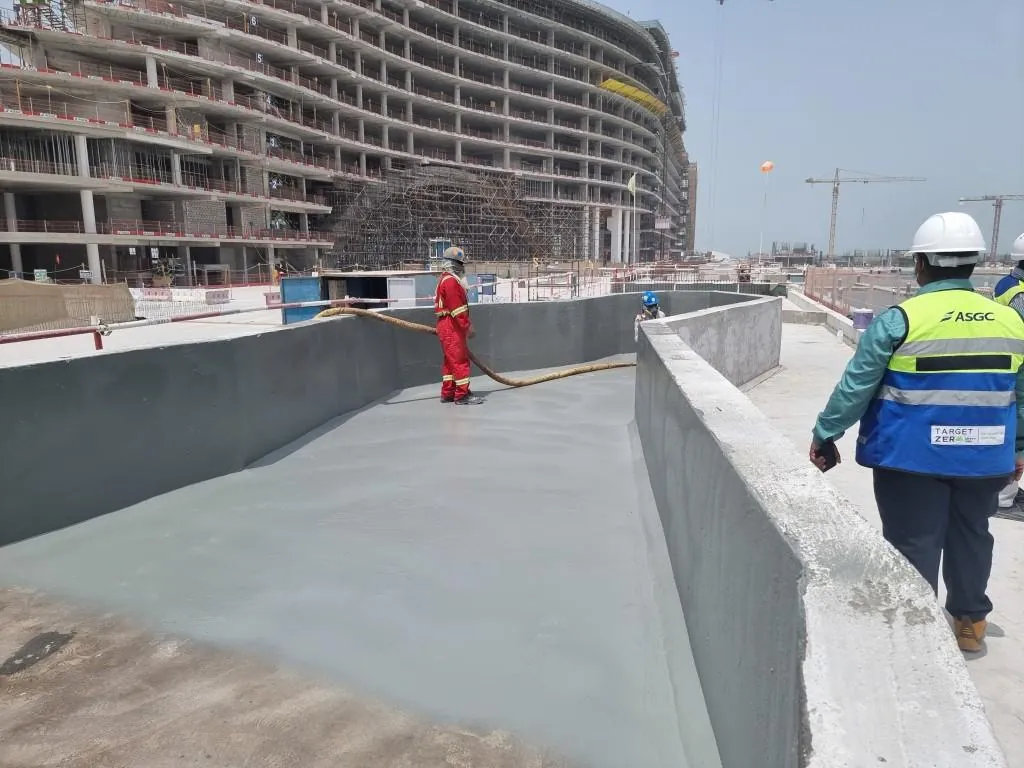
Work photographs
Frequently asked questions
At what stage should a waterproofing contractor be appointed?
Before excavation is complete, ideally when the foundation design is fixed. The substructure membrane must be laid before the raft pour, and construction joint details are needed before the first wall pour.
Do you work as a subcontractor to the main contractor?
Yes. We regularly work under main contractors and developers, following their programme, safety rules and inspection procedures.
Which areas need waterproofing in a new building?
Typically the raft and retaining walls, construction joints, lift pits, underground and overhead tanks, STP tanks, sunken toilets and bathrooms, balconies and chajjas, refuge floors, podiums, terraces and mumty roofs.
Do you provide test records?
Yes. Ponding and flood tests are recorded with dates and observations, and included in the handover file with inspection checklists.


