

What is lift pit waterproofing?
Lift pit waterproofing keeps the pit floor and walls dry. In new construction, the pit is wrapped externally with the same membrane as the raft, with careful detailing at the step down from raft to pit, which is a common weak point. Construction joints in the pit walls receive waterstops.
In existing buildings, the outside cannot be reached, so active leaks through cracks, joints and tie holes are sealed with PU injection from inside, followed by crystalline or cementitious coating of the pit surfaces, and correct sealing of buffer and rail fixings.
Benefits
- Dry pit for safe lift operation and maintenance
- Protects lift buffers, rails and electrical parts from corrosion
- Meets lift installer requirements for commissioning
- Treatment planned around lift downtime
Common problems and applications
Problems it solves
- Standing water in the lift pit after rain
- Water entering through the joint between raft and pit walls
- Leaks around buffer and rail bracket fixings
- Corrosion of lift components and pit ladders
- Lift company refusing to commission or service due to water
Where it is used
- Passenger and service lift pits in residential buildings
- Car lift and goods lift pits
- Lift pits in commercial and hospital buildings
- New lift pits under construction
Our lift pit waterproofing process
Coordinate with the lift company
The lift is parked and isolated by the lift technician before work begins.
Pump out and inspect
Water is pumped out, the pit is cleaned and each leak point is marked.
Seal active leaks
Cracks, the raft-to-pit joint and tie holes are sealed by PU injection grouting.
Repair and cove
Damaged concrete is repaired, and corners between floor and walls are coved with polymer mortar.
Apply waterproof treatment
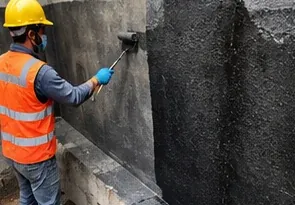
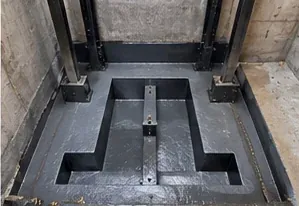
Crystalline slurry or cementitious coating is applied to floor and walls, with fixings sealed.
Monitor and hand back
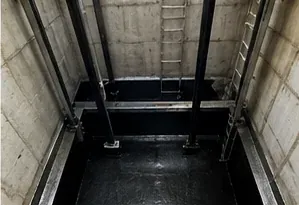
The pit is checked over the observation period and returned to the lift team dry.
Materials and systems used
- Water-reactive and flexible PU resins
- For sealing leaks under pressure.
- Crystalline waterproofing slurries
- For treating the concrete surface from inside.
- Polymer repair mortars
- For coving and patch repairs.
- External HDPE or bituminous membranes
- For new lift pits, continuous with the raft membrane.
Products are selected from the approved specification. Coverage, thickness and curing follow the manufacturer's current data sheet.
Why professional waterproofing is important
A lift pit is a small area that causes big problems. Because it sits under the highest water pressure in the building, surface coatings alone often fail. Leaks must be stopped at their paths first, then the surfaces treated.
Professional work also respects the lift equipment: isolation by the lift technician, protection of rails and buffers, and no drilling into components. A coordinated job gets the pit dry without causing new problems for the lift contractor.
Why choose us
- Lift-company coordination
- We plan with the lift technician so the pit is isolated and safe.
- Pressure-rated approach
- Injection before coating, because pits are under constant water pressure.
- Small-area specialists
- We bring compact equipment suited to confined pits.
- Part of basement work
- Lift pits are often treated alongside basement waterproofing.
Read more about our team and how we inspect and record work.
Work photographs
Frequently asked questions
Which waterproofing method is best for a lift pit?
For a new building, an external membrane continuous with the raft waterproofing, with waterstops at the pit wall joints. For an existing lift pit, PU injection grouting to stop the active leaks, followed by crystalline or cementitious waterproofing on the floor and walls, applied from inside. A coating alone rarely works in a pit because of the water pressure at that depth.
Why does water come into the lift pit even if the basement is dry?
The pit is deeper than the basement floor and the joint where it steps down from the raft is a common leak path. The pit is under higher water pressure than the rest of the basement.
How long will the lift be out of service?
It depends on the number of leaks and the treatment. Typical work takes a few days, scheduled with the lift company.
Can a sump pump solve the problem?
A pump removes water but does not stop it entering. Corrosion and humidity continue. Sealing leaks is the long-term solution, with a pump as backup where water pressure is very high.


